A Home for Liberatory Mental Health


This invitation appears in Arabic first, English, French, and Spanish translations follow below — please scroll down.
ترجمه‌ی فارسی در ادامه آمده است. لطفاً به پایین اسکرول کنید.
Traduction française ci-dessous.
Traducción en español a continuación.

إلى الأصدقاء والصديقات الأعزّاء

نحن اختصاصيّون واختصاصيّات في الصحة النفسية من فلسطين، جزءٌ من الشبكة الفلسطينية العالمية للصحة النفسية. ونكتب إلى الزملاء والزميلات في كل مكان ممن يشاركوننا هذا الالتزام أيًّا كنتم وأينما كنتم. نودّ أن نطرح عليكم مقترحًا، لا خطةً مكتملة، بل هي فكرةً نأمل أن نفكّر فيها معًا: بيتٌ مهنيّ خاصٌّ بنا، منفصلٌ عن الشبكات، وليس عن فلسطين وحدها.

ليس بيتًا عن فلسطين وحدها، فهذا يهمنا، ونودّ التأكيد عليه منذ البداية: نحن فلسطينيون وفلسطينيات، وفلسطين هي أولويّتنا دائمًا وفي هذه اللحظة التاريخية بالذات، إلّا أن هذا البيت ليس عن فلسطين وحدها، وليس للفلسطينيين والفلسطينيات وحدهم. فالممارسة التحررية مطلوبة أينما خضع الناس للقهر والتهجير وعنف الدولة في كل منطقة وفي كل نضال. فإن كنتم تشاركونا هذا الالتزام، فهذا البيت بيتكم أيضًا. وفلسطين تبقى جزءً منه ولكنّها ليست البيت كله.

وغايتنا: كثيرون وكثيرات منا لم نعد نشعر بالانتماء إلى المؤسسات التي درّبتنا، فهي تطلب منا أن نفصل التدخل السريري عن السياسي، وأن نصمت إزاء ما يُفعَل بمرضانا وبالعوالم التي يعيشون فيها. بعضنا غادر؛ وبعضنا أُقصي؛ وبعضنا يبقى لأنه يحتاج إلى بيت — إلى مكانٍ للانتماء، وللإشراف، وللاعتراف — ويشعر أنْ لا خيار آخر أمامه. وبعضنا يبقى لأن جهات الترخيص تشترط تعليمًا مستمرًّا لا توفّره، في الوقت الحالي، سوى هذه المؤسسات.

وهكذا نقترح أن نبدأ ببناء بيتٍ خاصٍّ بنا: جسمٌ مهنيّ دولي لمن يلتزمون بالممارسة التحررية — ونعني بها ممارسةً ترفض أن تفصل العلاج النفسي عن السياسي، ولا تغض الطرف عن الظروف التي يعيشها مرضانا

كيف يتميز عن الشبكات: الشبكات هي أجسامٌ للمناصرة. تطلق الحملات، وتصدر النداءات، وتنظّم حول فلسطين، وهذا عملٌ حيويّ ومستمرّ. أما ما نطرحه فهو شكل آخر: بيتٌ للمعالجين والمعالجات، مكانٌ نفكّر فيه معًا، ونسند فيه بعضنا بعضًا، ونلتقي فيه عبر البلدان واللغات والتخصصات. له حرية أن يتكلّم حين يستدعي الضمير ذلك، لكن الكلام ليس علّة وجوده،بل إنّ الانتماء هو علّته

كيف سيُنظَّم: الخطوة الأولى هي الميثاق والمبادئ التي تجمعنا. ومن هناك يأخذ الجسم شكله كمظلّة تنضوي تحتها فروعٌ مستقلّة، تتشكّل كلما تقدّم زملاء وزميلات لبنائها، تاركةً شكلها ينبع ممّن يجتمعون لا مرسومًا سلفًا. لجنةٌ تأسيسية، متعددة اللغات والتخصصات، تحمل العمل الأول وتحفظ الميثاق؛ ومع تشكّل الفروع تصبح لجنةً توجيهية تضمّ عضوًا من كل فرع، بحيث تشكّل الفروع نفسها المركز. وللبدء، لا يحتاج الفرع إلى أكثر من قائمةٍ بريدية، وينمو كلما مال الناس إلى حمله

ماذا نطلب: ليس الكثير الآن، فقط هذا: إن مسّت الفكرة قلوبكم، فبادروا لتعبئة هذه الاستمارة القصيرة لإضافة أسمائكم أو للانضمام إلى اجتماعنا الأول. سنشارك الموعد مع كل من يكتب لنا.

هذه رسالتنا الان. ومن يرغب في حمل الحلم معنا، فسنلتقي في بيتنا. وإن شعرتم بغياب بيتٍ كهذا، فإن هذه الرسالة تخاطبكم باسمكم

بمودة واحترام، زملاء وزميلات في الشبكة الفلسطينية العالمية للصحة النفسية


ENGLISH

Dear friends,

We are Palestinian mental health professionals, part of the Palestine-Global Mental Health Network. We are writing to colleagues everywhere who share this commitment, whoever and wherever you are. We want to bring you a proposal, not a finished plan, but an idea we hope we can think through together: a professional home of our own, separate from the networks, and not only about Palestine.

NOT ONLY PALESTINE: This matters to us, and we want to say it at the outset: though we propose it as Palestinians, and Palestine is our priority now, in this particular historical moment, this home is not only about Palestine, and it is not only for Palestinians. Liberatory practice is needed wherever people are subject to oppression, displacement, and state violence, in every region and every struggle. If you share this commitment, this home is yours too. Palestine is one part of that, not the whole of it.

WHY: Many of us no longer feel at home in the institutions that trained us. They ask us to keep the clinical separate from the political, and to stay silent about what is being done to our patients and the worlds they live in. Some of us have left. Some of us have been pushed out. Others stay because they need a home, somewhere to belong, to be supervised, to be recognized, and feel they have no other choice. And some stay because their licensing bodies require continuing education that, for now, only these institutions provide.

WHAT WE ARE PROPOSING: That we begin to build a home of our own, an international professional body for those committed to a liberatory practice, by which we mean a practice that refuses to hold the clinical and the political apart, and that stays answerable to the conditions our patients actually live in.

HOW THIS DIFFERS FROM THE NETWORKS: The networks are advocacy bodies. They launch campaigns, issue calls, and organize around Palestine, and that work is vital and continues. This is something else: a home for clinicians, a place to think together, to support one another, and to find one another across countries, languages, and disciplines. It would have the freedom to speak when conscience calls for it, but speaking is not its reason for being. Belonging is.

HOW IT WOULD BE ORGANIZED: The first step is the charter and the principles that bind us. From there, the body would take shape as an umbrella, with independent chapters beneath it, forming as colleagues come forward to build them, letting their shape emerge from who gathers, rather than being decided in advance. A founding committee, multilingual and multidisciplinary, would carry the early work and hold the charter; as chapters take shape, it becomes a steering committee with a member from each, so that the chapters themselves make up the center. To begin, a chapter needs nothing more than a listserv, and grows as people are inclined to carry it.

WHAT WE ARE ASKING: Not much right now, only this: if it speaks to you, fill out this short form to add your name or to join our first meeting. We will share the date with everyone who writes.

That is all for now. Whoever wants to carry it further, we will find each other there. If you have felt the absence of a home like this, this is addressed to you.

With warmth and respect,
Colleagues in the Palestine-Global Mental Health Network

فارسی

دوستان عزیز

ما متخصصان سلامت روان فلسطینی هستیم، بخشی از شبکه جهانی سلامت روان فلسطین. این نامه را خطاب به همکارانمان در سراسر جهان می‌نویسیم، به همه کسانی که در این تعهد با ما شریک‌اند، هر که هستید و هر کجا که هستید. می‌خواهیم پیشنهادی را با شما در میان بگذاریم؛ نه طرحی نهایی، بلکه ایده‌ای که امیدواریم بتوانیم با هم درباره‌اش بیندیشیم: خانه‌ای حرفه‌ای از آنِ خودمان، جدا از شبکه‌ها، و نه فقط درباره فلسطین.

نه فقط فلسطین: این نکته برای ما مهم است و می‌خواهیم از همان آغاز بگوییم: گرچه این پیشنهاد را ما به‌عنوان فلسطینی مطرح می‌کنیم، و فلسطین اکنون، در این لحظه تاریخی خاص، اولویت ماست، این خانه فقط درباره فلسطین نیست و فقط برای فلسطینیان هم نیست. عملِ رهایی‌بخش در هر جایی که مردم زیر ستم، آوارگی و خشونت دولتی قرار دارند لازم است، در هر منطقه و در هر مبارزه‌ای. اگر شما نیز در این تعهد شریک هستید، این خانه از آنِ شما هم هست. فلسطین بخشی از آن است، نه همه آن.

چرا: بسیاری از ما دیگر در نهادهایی که در آن‌ها آموزش دیدیم احساس خانه بودن نمی‌کنیم. این نهادها از ما می‌خواهند امر بالینی را از امر سیاسی جدا نگه داریم و درباره آنچه بر سر بیمارانمان و جهان‌هایی که در آن زندگی می‌کنند می‌آید سکوت کنیم. برخی از ما رفته‌ایم. برخی از ما را بیرون رانده‌اند. برخی دیگر می‌مانند چون به خانه‌ای نیاز دارند، جایی برای تعلق داشتن، برای دریافت سوپرویژن، برای به رسمیت شناخته شدن، و احساس می‌کنند چاره دیگری ندارند. و برخی می‌مانند چون نهادهای صدور پروانه از آن‌ها آموزش مداوم می‌خواهد که فعلاً تنها همین نهادها ارائه می‌دهند.

آنچه پیشنهاد می‌کنیم: اینکه ساختن خانه‌ای از آنِ خودمان را آغاز کنیم؛ نهادی حرفه‌ای و بین‌المللی برای کسانی که به عملِ رهایی‌بخش متعهدند. منظور ما از این عمل، شیوه‌ای است که از جدا نگه داشتن امر بالینی و امر سیاسی سر باز می‌زند و در برابر شرایطی که بیمارانمان به‌راستی در آن زندگی می‌کنند پاسخگو می‌ماند.

تفاوت این نهاد با شبکه‌ها: شبکه‌ها نهادهای مدافعه‌گری هستند. کارزار به راه می‌اندازند، فراخوان صادر می‌کنند و حول فلسطین سازماندهی می‌کنند، و آن کار حیاتی است و ادامه دارد. این چیز دیگری است: خانه‌ای برای درمانگران، جایی برای با هم اندیشیدن، برای پشتیبانی از یکدیگر، و برای یافتن یکدیگر در میان کشورها، زبان‌ها و رشته‌های گوناگون. این نهاد آزادی آن را خواهد داشت که هر گاه وجدان حکم کند سخن بگوید، اما سخن گفتن دلیل وجودی آن نیست. تعلق داشتن است.

چگونه سازماندهی می‌شود: نخستین گام، منشور و اصولی است که ما را به هم پیوند می‌دهد. از آنجا، این نهاد به شکل یک چتر درمی‌آید، با شاخه‌های مستقل در زیر آن، که هر گاه همکارانی برای ساختنشان پیش قدم شوند شکل می‌گیرند؛ شکل آن‌ها از دل کسانی که گرد هم می‌آیند پدید می‌آید، نه اینکه از پیش تعیین شود. یک کمیته موسس، چندزبانه و چندرشته‌ای، کارهای آغازین را بر عهده می‌گیرد و منشور را نگه می‌دارد؛ با شکل گرفتن شاخه‌ها، این کمیته به کمیته راهبری بدل می‌شود با عضوی از هر شاخه، به گونه‌ای که خودِ شاخه‌ها مرکز را تشکیل دهند. برای آغاز، یک شاخه به چیزی بیش از یک فهرست ایمیلی نیاز ندارد، و به همان اندازه که افراد مایل به پیش بردنش باشند رشد می‌کند.

آنچه از شما می‌خواهیم: فعلاً چیز زیادی نیست، تنها این: اگر این سخن با شما همدلی می‌کند، این فرم کوتاه را پر کنید تا نامتان را اضافه کنید یا به نخستین نشست ما بپیوندید. تاریخ نشست را با همه کسانی که بنویسند در میان خواهیم گذاشت.

فعلاً همین. هر که بخواهد این راه را ادامه دهد، همان‌جا یکدیگر را خواهیم یافت. اگر جای خالی خانه‌ای مانند این را حس کرده‌اید، این نامه خطاب به شماست.

با گرمی و احترام، همکاران شما در شبکه جهانی سلامت روان فلسطین


FRANÇAIS

Chers amis, chères amies,

Nous sommes des professionnel·le·s palestinien·ne·s de la santé mentale, membres du Palestine-Global Mental Health Network. Nous écrivons à des collègues du monde entier qui partagent cet engagement, qui que vous soyez et où que vous soyez. Nous souhaitons vous soumettre une proposition, non pas un plan abouti, mais une idée que nous espérons réfléchir ensemble : un foyer professionnel qui nous soit propre, distinct des réseaux, et qui ne concerne pas seulement la Palestine.

PAS SEULEMENT LA PALESTINE : Cela compte pour nous, et nous tenons à le dire d'emblée : bien que nous le proposions en tant que Palestinien·ne·s, et que la Palestine soit notre priorité en ce moment, dans ce moment historique particulier, ce foyer ne concerne pas seulement la Palestine, et il ne s'adresse pas seulement aux Palestinien·ne·s. Une pratique libératrice est nécessaire partout où des personnes subissent l'oppression, le déplacement et la violence d'État, dans chaque région et chaque lutte. Si vous partagez cet engagement, ce foyer est aussi le vôtre. La Palestine en est une part, non la totalité.

POURQUOI : Beaucoup d'entre nous ne se sentent plus chez eux dans les institutions qui les ont formé·e·s. On nous demande de séparer le clinique du politique et de garder le silence sur ce que l'on fait subir à nos patient·e·s et aux mondes dans lesquels ils et elles vivent. Certain·e·s d'entre nous sont parti·e·s ; d'autres ont été écarté·e·s ; d'autres encore restent parce qu'ils ont besoin d'un foyer, d'un lieu où appartenir, où être supervisé·e, où être reconnu·e, et estiment n'avoir pas d'autre choix. Et certain·e·s restent parce que leur ordre professionnel exige une formation continue que, pour l'instant, seules ces institutions offrent.

CE QUE NOUS PROPOSONS : Que nous commencions à construire un foyer qui nous soit propre, un corps professionnel international pour celles et ceux qui s'engagent dans une pratique libératrice, entendue comme une pratique qui refuse de tenir séparés le clinique et le politique, et qui demeure responsable face aux conditions dans lesquelles nos patient·e·s vivent réellement.

EN QUOI CELA DIFFÈRE DES RÉSEAUX : Les réseaux sont des organes de plaidoyer. Ils lancent des campagnes, publient des appels et s'organisent autour de la Palestine, et ce travail est vital et se poursuit. Ceci est autre chose : un foyer pour les clinicien·ne·s, un lieu pour penser ensemble, pour se soutenir les un·e·s les autres, et pour se trouver à travers les pays, les langues et les disciplines. Il aurait la liberté de parler quand la conscience l'exige, mais la parole n'est pas sa raison d'être. L'appartenance l'est.

COMMENT IL SERAIT ORGANISÉ : La première étape est la charte et les principes qui nous lient. À partir de là, le corps prendrait la forme d'une ombrelle, avec des sections indépendantes en dessous, se constituant à mesure que des collègues se présentent pour les bâtir, en laissant leur forme émerger de celles et ceux qui se rassemblent, plutôt que d'être fixée à l'avance. Un comité fondateur, multilingue et multidisciplinaire, porterait le travail initial et garderait la charte ; à mesure que les sections se forment, il deviendrait un comité de pilotage comptant un membre de chaque section, de sorte que les sections elles-mêmes constituent le centre. Pour commencer, une section n'a besoin de rien de plus qu'une liste de diffusion, et grandit à mesure que des personnes sont disposées à la porter.

CE QUE NOUS DEMANDONS : Pas grand-chose pour l'instant, seulement ceci : si cela vous parle, remplissez ce court formulaire pour ajouter votre nom ou pour participer à notre première réunion. Nous partagerons la date avec toutes les personnes qui nous écriront.

C'est tout pour l'instant. Celles et ceux qui voudront le porter plus loin, nous nous y retrouverons. Si vous avez ressenti l'absence d'un foyer comme celui-ci, ce message vous est adressé.

Avec chaleur et respect,
Les collègues du Palestine-Global Mental Health Network

ESPAÑOL

Queridos amigos y queridas amigas,

Somos profesionales palestinos de la salud mental, parte del Palestine-Global Mental Health Network. Escribimos a colegas de todo el mundo que comparten este compromiso, quienquiera que seas y dondequiera que estés. Queremos traerles una propuesta: no un plan terminado, sino una idea que esperamos poder pensar juntos: un hogar profesional propio, separado de las redes, y que no trata solo de Palestina.

NO SOLO PALESTINA: Esto nos importa, y queremos decirlo desde el principio: aunque lo proponemos como palestinos, y Palestina es nuestra prioridad ahora, en este momento histórico particular, este hogar no trata solo de Palestina, ni es solo para palestinos. La práctica liberadora es necesaria allí donde las personas se ven sometidas a la opresión, el desplazamiento y la violencia estatal, en cada región y en cada lucha. Si compartes este compromiso, este hogar también es tuyo. Palestina es una parte de eso, no su totalidad.

POR QUÉ: Muchos de nosotros ya no nos sentimos en casa en las instituciones que nos formaron. Nos piden mantener lo clínico separado de lo político y guardar silencio sobre lo que se les hace a nuestros pacientes y a los mundos en los que viven. Algunos de nosotros nos hemos ido; a algunos nos han apartado; otros se quedan porque necesitan un hogar, un lugar al que pertenecer, donde ser supervisados, donde ser reconocidos, y sienten que no tienen otra opción. Y algunos se quedan porque sus colegios profesionales exigen una formación continua que, por ahora, solo estas instituciones ofrecen.

LO QUE PROPONEMOS: Que comencemos a construir un hogar propio, un cuerpo profesional internacional para quienes se comprometen con una práctica liberadora, entendida como una práctica que se niega a mantener separados lo clínico y lo político, y que sigue siendo responsable ante las condiciones en las que realmente viven nuestros pacientes.

EN QUÉ SE DIFERENCIA DE LAS REDES: Las redes son organismos de incidencia. Lanzan campañas, emiten llamamientos y se organizan en torno a Palestina, y ese trabajo es vital y continúa. Esto es otra cosa: un hogar para clínicos, un lugar para pensar en conjunto, para apoyarnos mutuamente y para encontrarnos a través de países, idiomas y disciplinas. Tendría la libertad de hablar cuando la conciencia lo exija, pero la palabra no es su razón de ser. La pertenencia lo es.

CÓMO SE ORGANIZARÍA: El primer paso es la carta fundacional y los principios que nos unen. A partir de ahí, el cuerpo tomaría la forma de un paraguas, con capítulos independientes debajo, que se forman a medida que colegas se ofrecen a construirlos, dejando que su forma surja de quienes se reúnen en lugar de fijarse de antemano. Un comité fundador, multilingüe y multidisciplinario, llevaría el trabajo inicial y custodiaría la carta; a medida que los capítulos toman forma, se convierte en un comité directivo con un miembro de cada uno, de modo que los capítulos mismos constituyen el centro. Para comenzar, un capítulo no necesita más que una lista de correo, y crece a medida que las personas se inclinan a sostenerlo.

LO QUE PEDIMOS: No mucho por ahora, solo esto: si esto te resuena, completa este breve formulario para añadir tu nombre o para sumarte a nuestra primera reunión. Compartiremos la fecha con todas las personas que nos escriban.

Eso es todo por ahora. Quienes quieran llevarlo más lejos, nos encontraremos allí. Si has sentido la ausencia de un hogar como este, este mensaje va dirigido a ti.

Con cariño y respeto,
Colegas del Palestine-Global Mental Health Network

On the Fifty-Ninth Year of the Naksa

Published in CounterPunch.
On June 5, 2026

On June 5, 1967, over six days, some three hundred thousand Palestinians were driven from the West Bank, East Jerusalem, and Gaza. For roughly half of them it was a second expulsion in under twenty years. The official account calls it a war Israel had no choice but to fight. Menachem Begin admitted otherwise: the Egyptian troop movements, he said, "do not prove that Nasser was really about to attack us," and Israel chose to strike first. What the war secured was the territory Israel still occupies today. Palestinians called that June the Naksa, the setback. Fifty-nine years later, it is not something we look back on but something we still live inside — what Mahmoud Darwish called an extended present.

We write as Palestinian mental health professionals, in Palestine and in the shatāt. We know from our work that dispossession is never only a matter of borders and demography. It is a wound to the psyche, to a person's sense of who they are and where they belong. Forced displacement does not end when the trucks stop. It lives on in the body, in the family, and in the children of the people it first uprooted.

And the harm is deliberate. What the Zionist entity pursues is not only land but the murder of the Palestinian soul, the slow unmaking of a people's inner life. In the prisons, the United Nations Secretary-General's report on conflict-related sexual violence verified rape and genital violence against Palestinian men, women, and children in Israeli custody, and for the first time listed Israel's forces among those credibly suspected of such crimes. Inside the lands taken in 1948, Palestinian citizens of Israel face the same logic: Bedouin homes demolished by the thousand in the Naqab, people arrested over a post or a protest, grief and solidarity treated as offenses. To live through all of this and then be told your suffering cannot even be spoken is an injury in itself. Our profession has no right to watch it in silence.


The setback that has not ended

This week the clearest case is Lebanon. Israel signed a ceasefire and then used it as cover for war. After thousands of violations of the November 2024 truce, it opened a new assault in late February that has killed more than three thousand four hundred people and emptied cities across the south. Its forces have crossed the Litani, taken Beaufort Castle, and pushed north, and the bombing continues as we write. Many of those under the bombs are the refugees of 1948 and 1967 living in the camps of the south, displaced once more from the very places they had fled to. One of our sister networks works there, under fire.

Inside Palestine, the displacement of 1967 is happening again, in plain sight.

In the West Bank, 2026 has brought the highest rate of demolition-driven displacement in the seventeen years of UN records, alongside settler violence the UN calls unprecedented: roughly six attacks a day, hundreds injured, mosques and olive groves burned. The settlers do not act alone. The UN has found Israeli forces directing, joining, and shielding the attacks, until state and settler violence can no longer be told apart. In May, more than a hundred and thirty Bedouin villagers, most of them children, were driven from Jiljiliya, refugees expelled all over again, while B'Tselem records whole communities emptied off their land at a rate not seen in decades.

None of this is hidden; it is announced. Since early 2025, Israeli forces have emptied the refugee camps of the north, Jenin and Tulkarem, driving out some forty thousand people in the largest forced displacement the West Bank has seen in nearly sixty years. Israel's finance minister, Bezalel Smotrich, who also governs the settlements, has called for annexing most of the West Bank and for "encouraging the migration" of its Palestinians; the stated aim is as much land and as few Palestinians as possible. This April, at the rebuilding of a settlement evacuated two decades ago, he declared that Israel was "abolishing the disgrace of expulsion, killing the idea of the Palestinian state." His government is now advancing the E1 plan, a settlement bloc east of Jerusalem meant to split the West Bank in two and seal off East Jerusalem, and has ordered the expulsion of the Bedouin village of Khan al-Ahmar to clear its path. The word for all of it is the same word we used in 1967.

In Gaza, the ceasefire announced in October 2025 held only on paper. Its first six months brought more than two thousand four hundred violations, with hundreds more killed since. The territory is now split by a "yellow line" behind which Israel holds close to two-thirds of Gaza, having pushed it steadily west of the truce terms; Palestinians who cross that line, or only stray near a boundary often left unmarked, are shot on sight. The dead exceed seventy-two thousand, more than twenty-one thousand of them children, and tens of thousands more have been maimed. Famine has been confirmed, and most of those who have starved to death are children. These are not statistics to us. They are the patients, parents, and children we are supposed to be able to help.

In the prisons, more than nine thousand six hundred Palestinians are held: some three hundred and fifty of them children, more than three thousand five hundred without charge or trial. Over a hundred have died in custody since October 2023 under torture, starvation, and medical neglect; the bodies of dozens are withheld, and others have been disappeared. Israel's parliament has now passed legislation toward executing prisoners. None of this is the system breaking down. It is the system working.


What the world's institutions have already found

The naming has already been done, at the highest levels of law. In September 2025 the UN Commission of Inquiry concluded that Israel has committed genocide, finding four of the five genocidal acts and placing intent at the top of the Israeli government. The International Court of Justice has ruled the occupation unlawful and found Israel responsible for apartheid, and in the case brought by South Africa it found genocide plausible and ordered Israel to prevent it. Israel ignored those orders. The International Criminal Court has issued arrest warrants for Israel's prime minister and former defense minister. Amnesty International and Human Rights Watch have each found genocide, apartheid, extermination, and persecution. None of this is contested by the institutions built to judge it. The only open question is whether it may be said aloud.

The silence is not neutral

The crimes of the Zionist entity are now plain for everyone to see; they cannot be hidden in the open anymore. So the work of erasure has shifted onto the institutions, onto what the bodies that shape knowledge and conscience are allowed to say. The killing is one form of violence; forbidding it to be named is another, and the second protects the first. We see this in the institutions closest to us. The American Psychological Association moved to censor a lecture by Dr. Mansoor Malik. Springer Nature retracted a chapter by Samah Jabr, Sarah Mohr, and Elizabeth Berger on genocide and Palestinian collective trauma. A special issue of Psychoanalytic Inquiry appeared while refusing the word genocide. The International Psychoanalytic Association condemned Russia's war within days, yet across two years and tens of thousands of deaths it has named no crime in Gaza and called for no ceasefire, pleading legal constraints it never found when the war was in Europe. Its silence was not neutral. An IPA committee cast the assault as a fight of "light against darkness," and its president could bring herself to acknowledge only the suffering of "non-terrorist Palestinians," as if a Palestinian had to prove she was not the enemy before she was worth mourning.

Once the highest courts have named the crime, refusing to name it is not neutrality. It is a way of controlling what people are allowed to know — what scholars call academic denialism: careful, administrative language that lets a genocide be filed as a "conflict." The same move drives the demand for "balance." One clinician describes trying to name the trauma of Palestinian children and being told instead to keep "balance and objectivity," the appeal to evenhandedness arriving exactly where a child's pain was about to be spoken. This is the kind of harm we are trained to recognize: a person seen, counted, and documented, and left unprotected all the same, while accountability never comes and the killing goes on.

So we ask our colleagues in mental health, wherever they work, to keep naming it: the genocide, the apartheid, the torture, and the silence that shelters them. Naming costs us something. Refusing to name costs the people we are meant to serve far more.

Why we speak, and whom we thank

We refuse this erasure by naming what it hides. A people cannot mourn what it is not allowed to name, and without mourning there can be no repair.

Our gratitude goes, above all, to our sister networks — in Abya Yala, Argentina, Australia, Chile, Cyprus, Egypt, France, Germany, Greece, Indonesia, Iraq, Ireland, Italy, Jordan, Lebanon, the Netherlands, Palestine, South Africa, Spain, Sweden, Tunisia, the United Kingdom, and the United States — who have not abandoned us. And to the psychoanalysts who resigned from the International Psychoanalytic Association rather than lend their names to its silence, and who let their names be known: the founders of the Germany–Palestine Mental Health Network, Ferisde Eksi, Michals Kaiser-Livne, Iris Hefets, and Shirin Atili; Mary Adams and Denise Cullington in the United Kingdom; and Avgi Saketopoulou, Molly Merson, and Danny Gellersen in the United States. They resigned at real professional cost. What they did was harder than private disapproval: they withdrew, and they carried into their institutions the same thing we hold to in the consulting room, a refusal to become instruments of harm against the person in front of us.

Fifty-nine years on, we mark the Naksa not to lay it to rest but to insist that it has never ended. We will keep saying what is being done, and who is doing it, and we will not stop until saying so no longer takes courage.

— The Palestine–Global Mental Health Network June 2026

Our Call Restated: Two More Resignations

The Palestine-Global Mental Health Network, which jointly launched the IPA resignation campaign with our international sister networks, publishes this statement to mark our stand and to add two more letters to the public record.

We open with thanks.

Since our networks issued the call to resign from the International Psychoanalytic Association in February 2026, 616 colleagues have signed in support. Resignation letters have come from across the world. We are grateful to every signatory and to every colleague who has chosen this path. The decision carries professional cost. We do not take any of these resignations lightly, and we will not forget that you made them.

We are especially grateful to those who have made their resignations public, who put their names, their professional standing, and their reasoning on the record so that others would know they were not alone. Among them: the members of the Germany-Palestine Mental Health Network (Ferisde Eksi, Michals Kaiser-Livne, Iris Hefets, and Shirin Atili), whose November 2023 letter set the tone for what was to come; Mary Adams in the United Kingdom; Avgi Saketopoulou in New York; and Denise Cullington in the United Kingdom. Their letters can be read in full here.

Today we add two more.

Molly Merson, LMFT (Berkeley, California) and Danny Gellersen, LICSW (Seattle, Washington) have resigned from the IPA and have given us permission to publish their letters. Their full letters now join the others at the link above.

We thank Molly and Danny, and every colleague on the list. We thank those whose letters are public, those whose signatures stand alongside ours, and those who have written privately to the IPA without a public statement. Each of you has done the thing the moment requires.

Palestine-Global Mental Health Network speaks here, alongside our sister networks, to remind colleagues of what this call is about and why we are making it. We address those still inside the IPA, those weighing their position, and those watching from neighboring institutions.

What the Call Is About

This is a call in support of the Palestinian-led, non-violent resistance movement: the movement articulated since 2005 through PACBI and BDS, and endorsed by the absolute majority of Palestinian civil society. It is not a call against psychoanalysis, nor against our colleagues. It is a call to honor a non-violent strategy, designed by the people most affected, as the ethical path forward for institutions like ours.

This matters because the question of what one's membership means is sometimes treated as private, as ambiguous, as a matter of personal conscience. It is not. The IPA has been silent across more than two years and over 73,000 deaths. It has framed the genocide as "light against darkness." It has spoken of "non-terrorist Palestinians." It has condemned Russia's war on Ukraine within days while leaving Gaza unnamed. To hold membership in such an institution, while extending it legitimacy, dues, presence, and one's professional name, is to take a position. It is to participate in the cover the institution provides. The Palestinian-led movement asks us to recognize this clearly: the institution's silence is its complicity, and our continued membership is our share in it.

This is why resignation is the act we ask of you. It is not a gesture; it is the withdrawal of cover.

We Are Mental Health Professionals

We make this call as mental health professionals. Our work begins from the obligation to do no harm and to refuse complicity with harm. The ethic we hold in the consulting room is the refusal to be instrumentalized, the refusal to participate in a structure that injures the person before us. We hold this same ethic toward our institutions. We cannot lend our names to a body that uses them as cover for harm at this scale.

This is not in tension with our professional life; it is the precondition for it.

What the Guidelines Name as Complicity

The PACBI Guidelines are explicit about which institutions fall within the scope of the boycott, and on what grounds. The Guidelines call on:

"academics, academic associations/unions, and academic — as well as other — institutions around the world, where possible and as relevant, to boycott and/or work towards the cancellation or annulment of events, activities, agreements, or projects involving Israeli academic institutions or that otherwise promote the normalization of Israel in the global academy, whitewash Israel's violations of international law and Palestinian rights, or violate the BDS guidelines." (PACBI, Guidelines for the International Academic Boycott of Israel, Revised July 2014)

The phrase "or that otherwise" is the operative pivot. It separates two distinct grounds for boycott. The first concerns involvement with Israeli academic institutions. The second, beginning at "or that otherwise," applies to activities and projects that promote normalization, whitewash Israel's violations, or violate BDS guidelines, whether or not an Israeli academic institution is involved. The clause is addressed explicitly to "academic associations/unions, and academic — as well as other — institutions around the world." International professional bodies are within the frame, on their own conduct, by the Guidelines' own terms.

The same Guidelines name the diagnostic categories of complicity. Institutions are complicit through silence, through actual involvement in justifying, whitewashing, or otherwise deliberately diverting attention from Israel's violations of international law and human rights.

By the standard the Guidelines themselves articulate, in language addressed explicitly to international bodies, the IPA's own conduct has placed it within the scope of the boycott.

Why Normalization Is Refused

The guidelines are equally precise about why normalization itself is refused, and this clarity matters for us as mental health professionals.

The PACBI framework defines normalization as any project that brings Palestinians and Israelis onto the same platform without meeting two specific conditions.

First, the Israeli party in the joint project is required to publicly recognize the inalienable rights of the Palestinian people as set out in the 2005 BDS Call. These are: ending the occupation and colonization of all Arab lands and dismantling the Wall; recognizing the fundamental rights of Palestinian citizens of Israel to full equality; and respecting, protecting, and promoting the right of Palestinian refugees to return to their homes and properties as stipulated in UN Resolution 194. Recognition of these three rights is the first precondition. The recognition must be public and unequivocal, not private or implied. Without it, joint participation is normalization.

Second, the joint activity itself must constitute a form of co-resistance. The framework names exactly what resistance addresses. Co-resistance is resistance against the Israeli regime of occupation, settler-colonialism, and apartheid. It is not a softened version or an abstraction. These are the three pillars of the regime, named together as the object of joint struggle.

These two conditions are not aspirational. They are the operative test. A project that fails either is, by the framework's own definition, normalization. This holds regardless of how heartfelt the encounter, how moving the conversation, or how decent the participants.

The reasoning behind the test is ethical, not strategic. Dialogue, healing, and reconciliation that do not aim to end oppression privilege oppressive coexistence at the cost of co-resistance, because they presume the possibility of coexistence before the realization of justice and do not aim to disrupt the usual operations of institutional power. They tell the oppressed they can live with apartheid. They present the relationship between colonizer and colonized as symmetrical at the moment of greatest asymmetry. They function, in the framework's own language, as a colonization of the mind.

This is why the framework refuses coexistence and demands co-resistance. The only welcome relationship between those from the oppressor community and those from the oppressed is one that recognizes the basic rights of the oppressed and involves a common struggle against oppression.

We hold to this distinction without compromise. What we work toward is co-resistance against occupation, settler-colonialism, and apartheid, not the staging of equivalence while the bombs fall. The framework is not ours; it belongs to the Palestinian-led movement, and we accept it on its own terms.

The full articulation is published in the PACBI Anti-Normalization Guidelines and the 2005 BDS Call.

Palestine-Global Mental Health Network

STOP THE STATE-SPONSORED EXECUTION OF PALESTINIAN PRISONERS

URGENT INTERNATIONAL STATEMENT

The Israeli Knesset is advancing a law that mandates execution by hanging for Palestinian prisoners, when Israelis convicted of the same crime would get life imprisonment. The bill passed its first reading by a vote of 39 to 16 (Times of Israel). Haaretz confirmed it: same crime, two sentences, determined entirely by ethnicity. This bill strips all judicial discretion, eliminates presidential pardon, requires hanging within 90 days, and applies only to Palestinians in a dual-court system that explicitly exempts Israeli settlers (Adalah). 

It is important to note that capital punishment is a punitive measure that the rest of the world has spent decades dismantling. Over two-thirds of the world’s nations have abolished the death penalty in law or practice. In fact, even Israel has only carried out one civil execution in its entire history. That the Israeli parliament is now reinstating the capital punishment, as special treatment for Palestinians, is both racialized and discriminatory. The minister driving this bill, Itamar Ben Gvir, convicted of incitement to racism under Israeli law, wore a noose pendant to parliament and handed out sweets after the vote in celebration. The UN High Commissioner for Human Rights, Amnesty International, Euro-Med Monitor, and even Israel’s own Justice Ministry have all declared this legislation to be unlawful. The Fourth Geneva Convention also prohibits an occupying power from imposing the death penalty on protected persons. Every legal authority has said no. The bill is advancing anyway.

Palestinian detainees are not criminals. Under international humanitarian law, they are prisoners of a decades-long military occupation, protected persons under the Fourth Geneva Convention who should never have faced military tribunals in the first place. Many of them should have been released long ago under signed agreements between the parties. Instead, over 10,000 Palestinians remain imprisoned, thousands under administrative detention, held without charge, without trial, indefinitely renewable (Adalah). Among them are children as young as 14. The Israeli Information Center for Human Rights in the Occupied Territories B’Tselem has documented at least 12 facilities operating as systematic torture camps. The UN Committee Against Torture found a “de facto State policy of organized and widespread torture” that amounts to war crimes and crimes against humanity. At least 98 Palestinians have died in custody since October 2023. The ICRC has been barred from all visits for over 28 months. These are prisoners of war held in torture camps, denied the protections granted them by every international convention. And now Israel claims the legal authority to hang them.

While Israel advances this racial execution law, the United States is rewarding it with the largest military aid package in history. Since October 2023, the U.S. has sent $21.7 billion to Israel’s military, nearly six times the normal annual rate, delivered on 800 transport planes and 140 ships carrying 90,000 tons of weapons (Brown University / Quincy Institute). Every bomb, every bullet, every dollar says the same thing: carry on. America is not a bystander. It is the underwriter of this violence. And as long as the money flows without condition, Israel has no reason to stop. Not the torture. Not the detention of children. Not the executions, it is now being written into law.

SEND A LETTER. TODAY.

U.S. citizens and residents: Write to your Senators, Representative, the President, and Vice President. Follow this link

International and US citizens: Write to the President and Vice President of the United States. Follow this link

Everyone: Write to your own foreign ministry. Contact the U.S. Embassy in your country. Urge your professional associations to speak.

The people of Palestine are not asking for your pity. They are asking you to stop paying for the rope.


Palestine-Global Mental Health Network
  •  “No Healing Without Liberation”

Share this. Translate it. Print it. Do not stop until the bill is dead.

Grave Concern Regarding Attack on Gaza Community Mental Health Programme Facilities

Statement from the
Palestine-Global Mental Health Network
And the International Collective of the Palestine Mental Health Networks


Grave Concern Regarding Attack on Gaza Community Mental Health Programme Facilities

October 22, 2025

The Palestine-Global Mental Health Network and the international collective of the Palestine Mental Health Networks express our profound alarm and unequivocal condemnation of the armed takeover of the Gaza Community Mental Health Programme (GCMHP) facility in Gaza City on October 13, 2025.

This unconscionable attack on a vital mental health institution represents not only a direct assault on humanitarian infrastructure, but a devastating blow to the most vulnerable members of Palestinian society who depend on these critical services. The forcible seizure of this facility, which houses multiple clinics serving thousands of patients, constitutes a grave violation of all laws and norms, and a blatant assault on the sanctity of civil and humanitarian institutions working to serve the Palestinian people in these catastrophic circumstances.

We are particularly disturbed that this incident has occurred at a time when the Palestinian people in Gaza are facing the most horrific genocidal war in modern times and are experiencing unprecedented psychological trauma. We share GCMHP's grave concern that despite urgent written complaints to relevant official authorities requesting immediate intervention, no concrete action has yet been taken on the ground to ensure the return of the facility. This raises serious questions about the fate of civil society organizations operating in the field, and about the protection of law and public order at this critical stage. The continuation of this situation threatens the survival of the few remaining humanitarian service providers that Palestinians desperately need.

The GCMHP, which has served the Gaza Strip for nearly four decades, represents a beacon of hope and healing in a context of unimaginable suffering. The organization's work with children, women, the elderly, and victims of violence and trauma is irreplaceable. The Programme has courageously continued its life-saving work despite catastrophic losses, including the destruction of its main seven-story headquarters in Gaza City, its facility in Khan Yunis, and damage to its Deir al-Balah facility. The complete destruction of its alternative facility in the Shawa Building in September makes the forcibly seized facility the only one providing medical services to patients in Gaza City.

The continuation of this attack not only undermines the right of a national humanitarian organization to operate, but also strikes at the heart of the right of thousands of patients to psychological and health care, posing a direct threat to their lives and psychological stability at a time when their suffering is exacerbated by the ongoing siege, destruction, and displacement.

We join GCMHP in their call upon:

  1. The competent Palestinian authorities to immediately assume their legal, moral, and national responsibilities, intervene urgently to evacuate the facility and return it to the institution, ensure the safety of staff and patients, and hold those responsible for this attack accountable without any delay or leniency;

  2. The parties sponsoring the agreement to end the aggressive war on the Gaza Strip to intervene decisively to prevent any practices that undermine humanitarian work or threaten civil peace, recognizing that the continuation of such violations seriously casts doubt on the credibility of all international efforts;

  3. The international community, including humanitarian and human rights institutions, UN agencies, and humanitarian organizations, to take immediate action to protect civilian and humanitarian facilities and ensure their continued operation, free from any threat or interference from any party;

  4. All national and community forces and bodies to stand firmly against the manifestations of chaos and attacks on civil society institutions, recognizing that turning a blind eye to these acts threatens civil peace and undermines the remaining foundations of resilience and dignity in Palestinian society;

  5. The global mental health community to stand in solidarity with our Palestinian colleagues and provide enhanced support during this critical period.

The Palestine-Global Mental Health Network reaffirms our unwavering solidarity with the Gaza Community Mental Health Programme and our commitment to supporting mental health services for the Palestinian people. We stand with GCMHP in their affirmation that they will not relinquish their right to regain their facility, nor remain silent in the face of this attack on the essence of their humanitarian and national mission.

The international mental health community stands united in demanding immediate action to restore this vital facility and protect all humanitarian workers and institutions serving the Palestinian people. We recognize that attacks on mental health facilities constitute attacks on the most fundamental aspects of human dignity, resilience, and recovery.

We see this attack, as GCMHP has stated, as a painful stab in the heart of humanitarian work and a blatant violation of all remaining values. We affirm that the voice of truth will not be silenced, and that the will to serve and heal will remain stronger than any weapon.

Palestine-Global Mental Health Network and the International Collective of Palestine Mental Health Networks

On the Release of Ahmad Manasra

Today marks a moment of profound relief and cautious hope with the long-overdue release of Ahmad Manasra, a Palestinian child who was arrested by Israeli authorities in 2015 at the age of 13. After nearly a decade of unjust incarceration, solitary confinement, and deteriorating mental and physical health, Ahmad has finally been reunited with his family.

Ahmad Manasra was a minor, 13.8 years old, arrested in October 2015 in relation to a stabbing incident in occupied Jerusalem. Despite evidence that he did not participate in the act, he was subjected to violent arrest, physical (mainly brain ) injury, psychological abuse, and harsh interrogations—all without legal representation or the presence of his parents or lawyer. He was convicted of attempted murder in proceedings that raised serious concerns regarding due process and violations of the United Nations Convention on the Rights of the Child.  Initially sentenced to 12 years, his sentence was later reduced to 9.5 years. Despite multiple appeals and petitions for early release on medical and psychological grounds, the Israeli parole committees repeatedly denied them.

Ahmad’s physical and mental health deteriorated significantly, particularly during prolonged periods of solitary confinement beginning in November 2021. Despite being diagnosed and hospitalized within the prison system, his suffering was largely ignored by the authorities. International human rights organizations—including those focused on the rights of children—have repeatedly condemned his treatment and the inhumane conditions of his detention.

Ahmad’s release today is a moment of reflection as well as celebration. It serves as a stark reminder of unchilding, a reminder of the enduring trauma inflicted on Palestinian children under occupation. It is a call to action for all of us: to work for a future where no child is imprisoned, where recovery is prioritized over punishment, and where justice is not delayed—or denied, and where children’s agency and resistance against colonial monstrosity is respected.

In the days leading up to his release, the Palestine-Global Mental Health Network, in coordination with Ahmad’s family, mental health professionals, and support teams, worked to prepare for his return. We held preparatory meetings with his parents, his siblings, and extended family members, in close coordination with psychiatrists, psychologists, and social workers who have accompanied them on this deeply painful journey.

On the morning of April 10, Ahmad’s father and relatives arrived at the prison, where they waited for several hours. Around noon, they were informed that Ahmad would be released. However, instead of a coordinated and dignified handover, the prison authorities released Ahmad approximately 10 miles away from the facility—alone and disoriented. He was able to recall his father’s phone number, but it took considerable time for his family and support team to locate him in the desert and reach him. When we finally saw him, it was heartbreaking. Ahmad was visibly distressed, deeply disoriented, and emotionally overwhelmed.

Despite these conditions, Ahmad was able to return home. He underwent an initial medical evaluation at a hospital, but was too anxious and emotionally unsettled to remain there, insisting on returning to his family. He is now home, where we continue to provide follow-up support to him and his immediate family as he begins the long journey of healing. We remain in close contact with his uncle, father, and mother, and our mental health professionals are offering sustained care in the coming days.

Ahmad’s ordeal has left deep scars. This young man, who has spent over a third of his life in prison, much of it in solitary confinement, embodies the profound psychological toll of the Israeli occupation’s carceral regime on Palestinian children. His suffering is not his alone—he represents the story of so many Palestinian boys and girls.

We call upon the global mental health community, human rights advocates, and all people of conscience to support Ahmad and the many other Palestinian children in historic Palestine facing the settler colonial machinery of brutality. Let us turn this moment into renewed energy to interrupt the colonial unchilding, to call in loud voices to stop the genocide against our children, and to work together for justice, care, and collective liberation.

Misinformation, McCarthyism, and the Weaponization of Antisemitism: A Response to “Psychologists Against Antisemitism”

The Palestine-Global Mental Health Network strongly condemns the dishonest and inflammatory petition circulated by an ad hoc group calling itself Psychologists Against Antisemitism. This group does not formally represent the American Psychological Association (APA), yet it falsely postures as an authoritative body, exploiting APA channels to push a politically motivated agenda aimed at suppressing legitimate criticism of Israeli state violence. Alarmingly, several signatories of the petition hold prominent positions within the APA, giving the false impression that this document speaks for the association as a whole.

The petition is a textbook example of misinformation—a tactic the APA itself has warned against. The APA must acknowledge that this petition itself is a clear case of misinformation—one that has tangible and harmful consequences. It distorts critiques of Israeli apartheid and military aggression into accusations of antisemitism, undermining the real fight against discrimination while enabling the suppression of Palestinian rights and advocacy.

Exploiting Jewish Identity to Shield Israeli Crimes

A particularly dangerous aspect of this petition is its presumption to speak on behalf of all Jewish people while falsely equating expressions of horror and outrage over Israel’s mass destruction in Gaza with antisemitism. As Dr. Roy Eidelson, a Jewish psychologist and president of APA’s Division 48 (Society for the Study of Peace, Conflict, and Violence), has pointed out in his own response to this petition:

“Yet the petitioners seemingly portray expressions of horror and outrage over this mass destruction as instances of antisemitism.”

This deliberate conflation serves a singular purpose: to shield Israel from accountability by framing criticism of its military atrocities as a form of bigotry. Dr. Eidelson further clarifies that:

“But accusations of antisemitism that are used to silence, harass, and punish anyone who speaks out in support of Palestinian rights and against Israel’s aggression are something entirely different. They are false and deceptive charges, often designed to draw attention away from Israel’s merciless assault.”

This petition follows the standard playbook of organizations like the Anti-Defamation League and StandWithUs, which routinely label pro-Palestinian advocacy as antisemitic in an effort to deflect from the reality of Israel’s actions. Instead of engaging with the overwhelming evidence of war crimes, the petitioners resort to distortion and intimidation tactics to suppress dissent.

As Dr. Eidelson so powerfully concludes:

“What they shouldn’t do, in my view, is disguise and defend unwavering support for Israel—regardless of its actions—by leveling charges of antisemitism against anyone who disagrees with their stance or makes them feel uncomfortable about it.”

The APA must take a clear stance against this dangerous manipulation—one that weaponizes Jewish identity to silence criticism of Israeli policies while erasing the many Jewish voices who stand against Israel’s military occupation and ongoing genocide in Gaza. To allow such tactics of suppression to persist within its own institutional spaces is a dereliction of the APA’s stated commitment to truth, ethics, and justice.

The Continued Smear Campaign Against Dr. Lara Sheehi

Perhaps the most egregious aspect of the petition is its continued targeting of Dr. Lara Sheehi, despite her full exoneration by the U.S. Department of Education’s Office for Civil Rights (OCR) and an independent third-party investigation. The persistence of these false allegations is not only malicious but further proof that the petition lacks credibility and is driven by political repression rather than genuine concern for discrimination.

Palestine Legal’s Statement on Dr. Sheehi’s Exoneration

According to Palestine Legal, OCR not only dismissed the false claims against Dr. Sheehi but also found that George Washington University (GW) may have engaged in anti-Palestinian discrimination.

Furthermore, GW was forced to revise its protest policies and nondiscrimination policies after OCR determined that its actions disproportionately targeted Palestinian students and activists. Despite these clear legal conclusions, Psychologists Against Antisemitism continues to peddle baseless allegations, demonstrating a blatant disregard for truth and ethical accountability.

The American-Arab Anti-Discrimination Committee (ADC) Statement

Similarly, the ADC has denounced the attacks on Dr. Sheehi as part of a broader McCarthyist campaign aimed at silencing pro-Palestinian voices in academia. The APA must take a stance against such political suppression—especially when its own platforms are being misused to advance these malicious campaigns.

Shameful Selective Concern for Discrimination

The APA’s silence in the face of these intimidation tactics is both glaring and damning. When it comes to other oppressed groups, the APA has been vocal, issuing:

  • A formal apology for its role in perpetuating racism in psychological science.

  • A solidarity statement with Ukraine after Russia’s invasion.

Yet, when it comes to Palestinians, the APA not only refuses to take a stand—it enables the harassment and professional targeting of those who do. If the APA truly upholds equity, diversity, and inclusion, then why does it continue to ignore the systemic discrimination and repression of Palestinian scholars, students, and mental health professionals?

A Call to Reject Repression and Misinformation

The Palestine-Global Mental Health Network calls on the APA to immediately and unequivocally reject the false claims and repression tactics promoted by Psychologists Against Antisemitism. Specifically, we demand that the APA:

  1. Condemn the McCarthyist attacks on scholars and professionals who speak out against Israeli apartheid and genocide.

  2. Acknowledge that the petition is a politically motivated smear campaign designed to suppress Palestinian advocacy.

  3. Recognize that misinformation—when tolerated—has serious consequences, as the APA’s own research has demonstrated.

  4. Uphold the integrity of psychological science by rejecting ideological manipulation and ensuring that APA platforms are not used to spread disinformation and defamatory claims.

  5. Address the growing issue of anti-Palestinian racism within its own ranks, particularly in how Palestinian members and allies have been harassed for speaking out.

The APA must decide whether it will allow itself to be used as a tool of political repression or stand on the side of truth, ethical scholarship, and justice for all people—including Palestinians.

We refuse to be silenced. The Palestine-Global Mental Health Network will continue to challenge these deceptive, harmful tactics and expose the weaponization of antisemitism to shield oppression and state violence.

Open Letter by Psychoanalysts Opposing the Palestinian Genocide

From:

Psychoanalysts Talk Back
To: 
All psychoanalysts, psychoanalytic clinicians, anyone interested in psychoanalysis

Follow this link for Arabic translation.
Follow this
link to see the letter in different languages and to see who has signed it

December 23, 2024

Today marks the 444th day of the genocide in Palestine. We are appalled that for over 15 months our psychoanalytic institutions, societies, and professional bodies have refused to take an ethical stance against the genocide and the varied crimes against humanity committed by Israel and its occupying forces. 

Even as organizations such as Amnesty International, Human Rights Watch, Médecins Sans Frontières, B’tselem, the International Court of Justice (ICJ), the European Center for Constitutional and Human Rights (ECCHR), and Francesca Albenese, the United Nations Special Rapporteur on the Occupied Palestinian Territories are reaching a consensus that the violence in Palestine is genocidal and that Israel is practicing apartheid in the Occupied Territories, we are not aware of a single psychoanalytic organization that has issued a statement condemning the violence and barbarity of Israel's expansionist project, undertaken with the United States', the UK's, and Germany's unabashed support; its vicious murderousness of Palestinian life, which has wiped out entire generational lines; its purposeful targeting of children; its brazen disregard of international law; its hateful and deliberate destruction of infrastructure, which makes survival in the land of Palestine untenable; its targeted killing of medical staff, mental health professionals including psychologists and psychiatrists, and of journalists; and the horrific acceleration of climate change due to the tons of emissions caused by the bombardments and ground invasion. 

Despite the fact that this barbarity is being live-streamed, making this the most documented-in-real-time genocide in human history, our professional organizations have failed us by not naming what's occurring -naming being one of the utmost values of psychoanalysis. Not only have they proceeded with business as usual, betraying some of the most important ethical principles of bearing witness, they have used psychoanalytic concepts (such as "splitting") to actively deter - and even pathologize - psychoanalysts from using analytic ideas to understand this unfettered violence.

If no one else will do it, Psychoanalysts Talk Back will.

We invite psychoanalysts, psychoanalytic candidates, psychoanalytic therapists, and anyone interested in psychoanalysis to sign this letter in order to: express how heartbroken and outraged we are by the ongoing and horrific conditions of death and land theft in Gaza and by our institutions' lack of outspoken opposition; stand in solidarity with our Palestinian, Lebanese, Syrian, and Yemeni colleagues, who have been made to watch their organizations mount events that justify Israeli violence, abandoning ethical commitments to human rights; and recognize the pain experienced by many of our anti-Zionist Jewish colleagues.

DEI initiatives that address gender, sexuality, and racism within psychoanalysis mean nothing as long as the field remains silent regarding Israel's genocide. Never has psychoanalysis felt and acted more white: this is the time to distance the field from imperialist, racist, colonial, and ethnonationalist projects. We demand that:

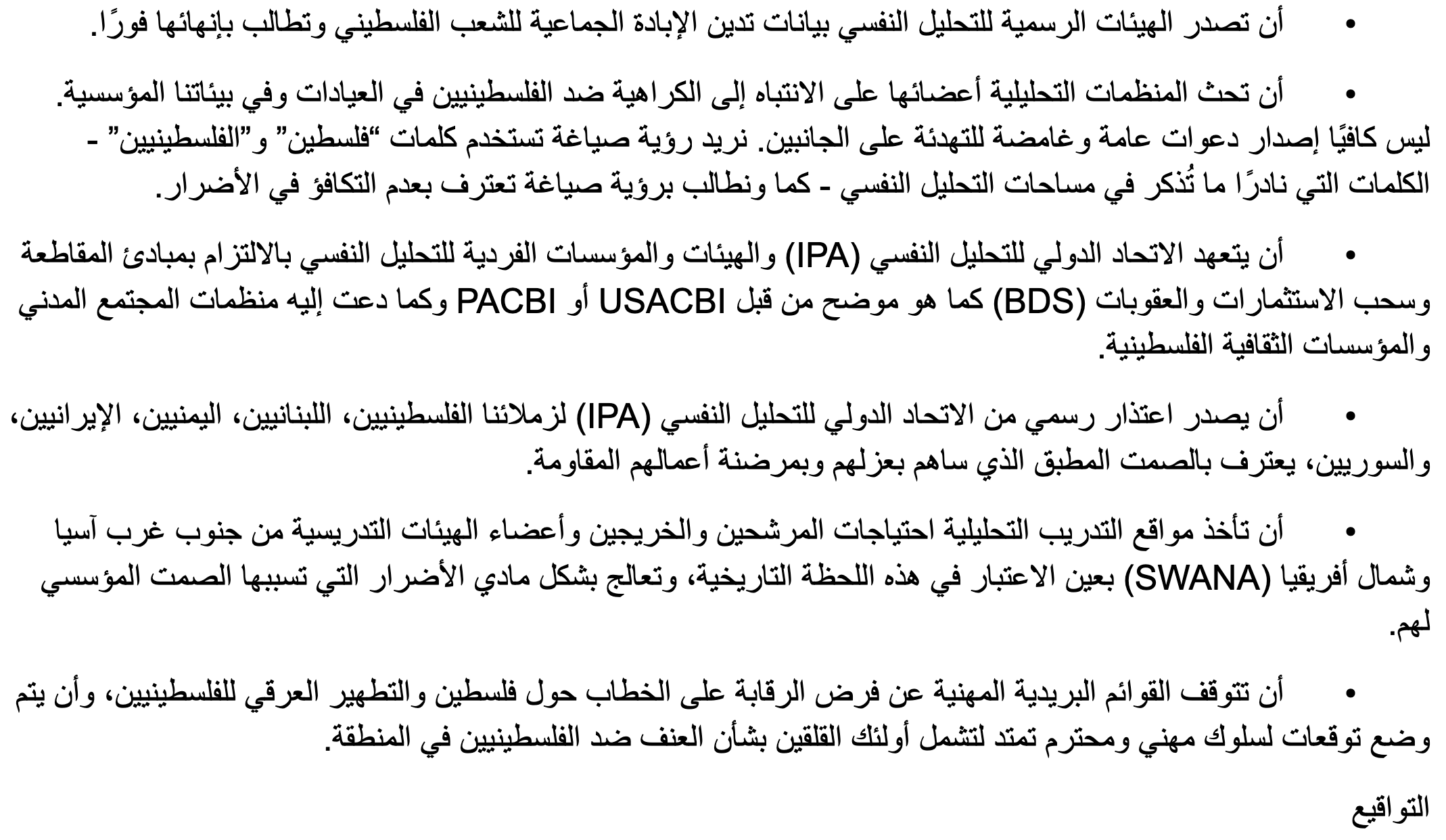
  • Formal psychoanalytic bodies issue statements condemning the genocide of the Palestinian people and demanding an end to the genocide now.

  • Psychoanalytic organizations urge their members to be attentive to anti-Palestinian hatred in the clinic and in our institutional environments. It is not enough to issue broad and generic calls for civility on both sides. We want to see phrasing that uses the words "Palestine" and "Palestinian" - words rarely uttered in psychoanalytic spaces -and which acknowledges the uneven harm.

  • The IPA as the formal analytic body and individual and Psychoanalytic Societies Institutions pledge to uphold the principles of Boycott, Divestment, and Sanctions (BDS) as outlined by USACBI or PACBI and as called for by Palestinian civil society and cultural organizations.

  • A formal apology be issued by the IPA to Palestinian, Lebanese, Yemeni, Iranian, and Syrian colleagues acknowledging the deafening silence that has isolated and pathologized them and their acts of resistance.

  • Psychoanalytic training sites actively consider the particular needs of Southwest Asian and North African (SWANA) candidates, graduates, and faculty at this historical moment, and materially address harms institutional silence has caused them.

  • Professional listservs stop censoring speech about Palestine and the ethnic cleansing of Palestinians, and that expectations be set for a professional and respectful attitude being extended to those concerned about anti-Palestinian violence in the region.

Signed,

A Cry from Gaza’s Ruins: The Genocide Will Continue if Israel’s Impunity Persists

The Palestine Mental Health Networks call out in anguish and outrage at the obliteration of the Kamal Adwan Hospital as part of the ongoing genocide. This space, meant to shelter and to heal, has been consumed by flames, its wards reduced to ashes by the calculated destruction of the Israeli military forces.

The Wreckage of Hope

The assault on the Kamal Adwan Hospital is not merely a tragedy--it is an atrocity. Patients, many of them children, were torn from their beds as fire and violence consumed the hospital. Dozens of staff, including its Director Dr. Hussam Abu Safiya, were taken by force. Their fate remains shrouded in uncertainty, as fear and despair grip their families and the shattered remnants of the hospital’s community.

These are not isolated incidents. Since October 2023, Gaza has become a graveyard for hope, a collective graveyard for Palestinians. Over 45,000 Palestinians have been killed. Nearly the entire population of Gaza has been displaced. The blockade tightens like a noose, and Gaza’s healthcare system—a basic human right—has been reduced to ruins. The World Health Organization’s stark words haunt us: Gaza’s health system is being systematically dismantled, a “death sentence for tens of thousands.”

A Cry from the Abyss

What remains when hospitals burn? When doctors are incarcerated, tortured, and silenced? When children gasp for air because oxygen tanks cannot cross blockades? This is not war. It is annihilation. It is the slow, deliberate suffocation of a people. It is genocide.

Every demolished hospital, every patient left to die in rubble, every child’s lifeless body pulled from the wreckage—these are not accidents. They are not “collateral damage.” These are crimes against humanity, calculated acts of genocide, carried out in full view of a world that watches in silence.

Where is justice? Where is humanity? What will it take to awaken the world from its indifference?

A Plea to the World

We can no longer accept impunity. We require:

  1. Immediately Stop the Genocide: Overkilling in Gaza cannot continue. The blockade is a death sentence. Its continuation is a stain on the conscience of humanity.

  2. Open Humanitarian Corridors: Let ambulances pass. Let medicine flow. Let Gaza breathe.

  3. Protect Healthcare Facilities: Enforce the laws that bind us all as human beings. Protect what remains of Gaza’s hospitals and clinics.

Impunity that Kills

Neutrality in the face of genocide is complicity. Every moment of silence and failure to hold Israel accountable feeds the fire that consumes Gaza. Every moment of inaction allows another hospital to fall, another child to die, another family to be torn apart.

This is a cry from the ruins of the Kamal Adwan Hospital. This is the scream of Gaza’s mothers burying their children. This is the wail of doctors forced to turn away the dying. The world is watching. Will you act, or will you look away again?

Join the Struggle for Justice

Here’s how you can help:

  1. Sign the Petition No Child A Target.

  2. For US residents— please sign the Petition:Not Another Hospital”.

  3. Share this Article: Amplify Gaza’s cry by sharing it with your networks.

  4. Demand Action: Protect Gazans NOW. Hold Israel accountable NOW. Contact your governmental representatives and demand that they protect Gaza’s people and its healthcare.

  5. Call on world leaders to impose an arms embargo on Israel NOW.

  6. Heed the call of Palestinian civil society for the Boycott, Divestment, and Sanctions movement—abide by its guidelines and encourage your network to do the same. 

We Can’t Wait Any Longer

Failing to respond to the ongoing catastrophe is not an option.

This is not just Gaza’s cry. It is humanity’s scream for justice. The destruction of the Kamal Adwan Hospital is an assault on every principle we hold dear. It is a call for all of us to rise, to speak, and to act.

Let this cry not fade into silence. Let it echo until justice is served.

Do not look away. Do not stay silent. Humanity must act.

ACT NOW.

THIS IS OUR MOMENT TO CREATE CHANGE AND TO STOP THE GENOCIDE.

Letter from Dr. Jessica Benjamin to Palestinians Living on the Stolen Land of 1948

Received on
June 14, 2024

Dear Friends and Colleagues of the Arab Israeli community:                    
In the past two weeks I’ve had several talks with Roney Seour about the webinar that had been planned from Blindness to Insight but as you know in respecting the call for boycott I did withdraw from participation in the webinar. I wrote a letter to the Jewish Israeli participants but I wanted to communicate to you in a different vein. After all, of course the matter for you isn’t being blind to what is being perpetrated in Gaza —rather it is having to carry the knowledge while still interacting with the majority of people, Jewish colleagues neighbors others,  who do not see or acknowledge, who deny the reality  or even support the violence  . We do hear about how painful and frightening this is in alternate media—how much repression there is right now, the new McCarthyism we see all over,  as well as how much aggression you see everywhere and is often directed at you.                  
Witnessing the horrific violence and destruction visited upon your people in Gaza must be a daily agony, multiple times more than for us who wake up every day facing more of the same news images and stories. And of course here in the US Palestinian voices have been silenced, people have been fired for refusing to sign statements against BDS or  for criticizing Israel. In fact the vortex created by those who defend the war against the Gazan people  grows more intense as our progressive leaders in Congress are under vicious attack,  those of color but also Jews who defend Palestinian rights. The rightwing forces in America, in Europe as well as Israel have gathered up Palestine as another weapon in their armament against equality and justice, affecting all of us, but your own specific oppression and the splits you must deal with in daily life shouldn’t get overlooked or minimized. It is traumatic. I hope when at least some of us  have a chance to talk together under other auspices that we can talk about your situation and the solidarity that we all need to give to you and provide for each other. I know this is only the least we can do but I wanted to make sure that we find find ways for your experience to be honored and shared.                      
 With my warmest regards and solidarity,  

Jessica Benjamin.

Letter from Dr. Jessica Benjamin to the Palestine-Global Mental Health Network
Received on
June 3, 2024

Dear Palestine Global Sisters and Brothers,

I am deeply apologetic that I did not find out about this appeal until today. I believe it must have escaped my attention because there are so many "urgent appeals" for funds in my Inbox, but whatever the reason be assured I would not have delayed my response. I am very surprised that no one wrote to me or called me among all my friends and political associates. Whatever the case, I only found out about it this week.

After serious thinking and consulting with my trusted friends I have concluded that I must, indeed, withdraw from participating in the seminar. Were the seminar sponsored only by my colleagues in Psychoactive whom I know, and whom I know to be opposed and actively against the genocidal actions of the Israeli state, perhaps there might be a different conclusion. But I fully agree I cannot participate in an event with any official institution that has not condemned the ongoing crimes against humanity occurring now in Gaza and the West Bank.

In fact, I have declined to speak or contribute to any Israeli institution for many years, at least since the Cast Lead attack on Gaza, that does not take a position on the Occupation and these violent assaults on civilian populations in Gaza, and of course none of these have even approached the scale of destruction and horror of the current attacks.

Be assured that every day since October 7th I have struggled with the horrific pain of witnessing the horror that is being visited upon Gaza; it has been hard to think of anything else.

I should explain that my impulse to make an exception in this case was due to the fact that there is so little international support for the small but not irrelevant Israeli Left opposition to their government’s horrific actions. I felt a pull to show them some solidarity, in the hope that they could become a stronger force for resistance. Some of these individuals have spent a considerable part of their adult lives in working for justice for Palestinians, also in providing care and teaching wherever possible. But in this case they will have to do their best to convey my regret, and the reasons why I cannot give any credibility or legitimacy to the institutions in our field that deny the transgressive, immoral, and illegal acts of violence perpetrated by their government and avoid confronting the acceptance or(more likely) approval of these acts by their own people.

My work, especially on the idea of acknowledging oppression and harming, has been and I hope will continue to be connected with nonviolence, with universal respect for human rights, equality and justice for all, as well as with international law. I understand the importance of your support for the nonviolent efforts of the Palestinian people to struggle for their freedom and dignity against the oppressive Israeli occupation and its transgressive violence. Especially at this moment, I believe these principles are necessary to keep the world from descending into chaos and despair, and I recognize that the violations of law and human rights by my own United States government have contributed greatly to this descent. For this too, I wish to take responsibility and encourage my colleagues to do the same. Indeed, it is all the more important to stand up for these principles in the awareness of how often reference to law and rights have been abused and mouthed by hypocrites such as the officials in my government who have helped to perpetrate the genocide in Gaza. Each of us must do our best to fight against those mystifications as well as the despair and helplessness that afflicts us as we witness this.

Since I was a young adolescent in the civil rights movement in the US I have witnessed the difficulties of holding on to our beliefs and principles in the face of the concerted effort of those in power to discredit, repress and in many cases harm those who resist oppression. Part of their strategy, of course, involves masking and denying the reality of harming. Now, as a therapist involved in personal and collective trauma, I have learned how essential it is for us to break that denial and acknowledge harming; also, how vital it is for people who have been oppressed and violated to receive full acknowledgment and affirmation of their injuries and their demand for redress. These ideas were confirmed and clarified most powerfully by learning from the practice of my late friend Dr. Eyad el Sarraj, who, as you know, was a great proponent of nonviolent resistance and psychology in Gaza. It was also my privilege to support the nonviolent psychosocial organizing of my late friend Ahmed Abu Tawahina.

So today I also want to give you as best I can my acknowledgment for the terrible, almost inconceivable suffering and injustice your people are going through. I know it is not enough. I also want to express my appreciation for your commitment to supporting the boycott as part of the nonviolent movement of the Palestinian people.

Please accept my apology again for my delay in responding and convey my solidarity to all who support the people of Palestine in this moment of great need.

In Solidarity, for Peace and Justice,

Jessica


Urgent Appeal

Support our Non-Violent Resistance
Divest from Zionist Academic institutions

Letter sent on
May 8, 2024

Dear Drs. Jessica Benjamin and Roni Srour:

We represent the Palestine-Global Mental Health Network, composed of Palestinian mental health professionals and scholars from historic Palestine and the Diaspora, alongside our partner Networks in Australia, Canada, France, Ireland, Germany, the United Kingdom, and the United States. We write to express our urgent concern regarding your planned participation in an upcoming webinar in Tel Aviv on June 17 at 7:00 PM.

The event’s venue, the Contemporary Institute for Psychoanalysis in Tel Aviv, has not publicly addressed the ongoing war crimes against the Palestinian people, including what has been deemed by the International Court of Justice as a plausible case of genocide in Gaza and the rampant pogroms assisted by the Israeli Occupation Force throughout the rest of Palestine resulting in the killing of nearly 500 adults and nearly 100 children people since October.7th

Over the past six months in Gaza, 34,797 people have been killed by bombs, guns, or starvation, among them 13,800 children and 8,400 women. Twelve universities in Gaza have been destroyed while hundreds of university students, Deans, and scholars—including many colleagues in the field of mental health—have been killed by the Israeli attacks. No one can be blind to these well-documented facts.

The Institute’s silence on these matters contravenes the fundamental ethical principle of "Do no Harm," signaling its complicity in these atrocities.

Palestinian civil society has called for global support of non-violent resistance, notably through the Boycott, Divestment, and Sanctions (BDS) movement. This initiative seeks to pressure Israeli academic and cultural institutions that are complicit in perpetuating war crimes and the destruction of the lives of Palestinians, who are denied rights recognized in international law.

The vague and generalized title of the meeting you plan to attend avoids irrefutable evidence of sustained violence and human rights abuses, and thus endorses the oppressive status quo.

By participating, you lend legitimacy to the narrative that has justified the oppression, dispossession, and killing of Palestinian men, women and children over the past seventy-five years.

In light of these issues, we urge you to support the BDS movement and realign with the principles of justice and ethical responsibility. We also encourage you to disengage from the Contemporary Institute for Psychoanalysis and refrain from normalizing ongoing conditions.

We ask you to stand with us on the right side of history. Your moral integrity and commitment to justice are crucial. Please do not lend credibility to a narrative that silences the oppressed. We trust in your principled stance and look forward to your supportive response.

Thank you for considering our call to action. 

Sincerely,

Palestine-Global Mental Health Network
Australia-Palestine Mental Health Network
Canada-Palestine Mental Health Network
France-Palestine Mental Health Network
Ireland-Palestine Mental Health Network
Germany-Palestine Mental Health Network
Netherlands-Palestine Mental Health Network
South Africa-Palestine Mental Health Network
Sweden-Palestine Mental Health Network
United Kingdom-Palestine Mental Health Network
United State-Palestine Mental Health Network 

Concerns Regarding the Content of Your Lecture on Anti-Semitism and Palestine

Dear Ladies and Gentlemen

A lecture will be given at your annual conference: "Thoughts for the Times on Anti-Semitism: Hatred and Destruction, the Past in the Present” by Shmuel Erlich and Mira Erlich-Ginor, the abstract of which can be read on the program. There it is stated that, “Anti-Semitism has been part of Judeo-Christian-Islamic culture for centuries, taking various forms and expressions. After its most horrendous and destructive outburst in the 20th century Holocaust, it gave rise to the collective determination: “Never Again!” Yet recent and current genocidal outcries against Israel and the Jews testify to the enduring power and relentlessness of anti-semitism.“

These statements are presented here as facts requiring no empirical findings: Phenomena which then are to be subsequently researched and interpreted under a psychoanalytical magnifying glass supported through the perspective of group dynamics.Anti-Semitism is a European-Christian phenomenon whose roots are to be found in Christian anti-Judaism. Only later and much less frequently can it be found in Muslim societies. In its most destructive form, it was only present in Europe and culminated in the German genocide of the Jews. While German Christians were enslaving, deporting and murdering millions of Jews, many Jews (and also non-Jews, such as Ernst Reuter, the former mayor of Berlin, where this conference is being held) were able to flee to Turkey and survive. In Albania, a Muslim state, Jews were protected from the Nazi horror by the government. Jews from Libya and Morocco were sent to concentration camps only after these countries were occupied by the Germans. To claim that anti-Semitism has been a part of Islamic culture "for centuries" is a tendentious rewriting of history that serves to relativize the German-European Christian's share of responsibility for the extermination of Jews by projecting its anti-Semitic motives onto the Muslim world. The DPG thus adopts the revisionist view held by far-right parties such as the AfD or Front National.

Further on in the abstract it is written: "recent and current genocidal outcries against Israel and the Jews". This statement is as well made without any empirical evidence to support it. While Israel is before the International Court of Justice in The Hague, where an overwhelming majority of judges speak of genocide against the Palestinians, here the opposite is claimed. The genocide of the Jews was committed by Germany and ended in 1945. The DPG was a participant in the ethnic cleansing of Jewish analysts during the National Socialist era. And today, even if Jews in different part of the world suffer from anti-Semitism and their lives are threatened, such as in Pittsburgh or Halle (both attacks were carried out by White Christians), they are nonetheless not currently suffering from genocide.

The Hamas attack on October 7 and its terrible consequences for the people living there are placed by the authors in the context of anti-Semitism. The fact, however, is that people living in Israel-Palestine were massacred, including Buddhists from Thailand, Muslims from Palestine, Bedouins, Jews - because they were in Israel. Even though the majority of those killed were innocent civilians, murdered in violation of international law, this was neither genocide nor an anti-semitically motivated act. Anti-Semitism is directed against the identity and existence of a Jew and not against his or her actions.

Jews in Israel-Palestine are killed and injured by Palestinian people in the context of displacement (numerous massacres of the Palestinian civilian population since 1948), occupation, oppression and the apartheid system. In South Africa, white people were killed in ANC terror attacks because they were part of the apartheid system. Their killing was not an "anti-white" action.

The fact that the DPG, as a German society, undertakes such a rewriting of history in its program is one aspect of the problematic nature of this lecture. In addition, the scientific standards that are necessary for psychoanalysis are ignored. In order to propagate a political agenda, an untrue assertion is made and this assertion, presented as fact, then becomes the subject of investigation. This analogous with the claim - and this is what psychoanalysis has done - that homosexuality is pathological and based on this assumption, this supposed pathology has been investigated.

Then we see the Past in the Present in action: Trans-generational traumas are not separate from current traumas. This has led to a distortion of history in which the past genocide of Jews is perpetuated as a permanently present threat and has thus led to a distorted perception of reality. This is being done while Israel is waging a war of extermination in the Gaza Strip. In this way, annihilating violence is denied through perpetrator-victim reversal.

Israel has "created" more than 19,000 orphans in the Gaza Strip because it has killed more than 6,000 Palestinian mothers in its genocidal actions. Palestinians live in a permanent state of traumatization. Many Israelis suffer from symptoms of post-traumatic stress disorder as a result of their participation in this genocide. News reports and visual images of ongoing physical and psychological violence (including the murder of more than 14,000 children, destruction of more than 70% of homes, targeted execution of medical personnel in order to destroy the health system, disruption of all food supply deliveries, numerous mass graves....) can lead to the loss of the viewer's ability to mentalize, so that the crimes of ethnic cleansing are broadcast live viansocial media without subsequent action.

We are extremely concerned about the development of the psychoanalytical discourse, which risks failing to recognize the immeasurable suffering caused by the current genocide of the Palestinian people, trivializing the devastating violence to which Palestinians are exposed and at the same time relativizing German anti-Semitism. Many people in Germany are directly or indirectly affected and traumatized by this genocide.

We expect that you, as a German psychoanalytical society, to fulfill your historical obligation and immediately end your intellectual and emotional support for the genocide of Palestinians and instead promote a differentiated view of the political situation. We therefore urge you to fundamentally rethink this and future programs and political positions. As a psychoanalytical society, it is your duty to call for an immediate end to the genocide!

Signed by

the Steering Committees of:

Palestine-Global Mental Health Network
Australia-Palestine Mental Health Network
Canada-Palestine Mental Health Network
France-Palestine Mental Health Network
Ireland-Palestine Mental Health Network
Germany-Palestine Mental Health Network
Netherlands-Palestine Mental Health Network
South-Africa-Palestine Mental Health Network
United Kingdom-Palestine Mental Health Network
United States-Palestine Mental Health Network.

نداء من أجل الحياة: أوقفوا الإبادة الجماعية في غزة

نحث مؤيدينا وحلفاءَنا على

استهلاك ما ينتشر في وسائل الإعلام بشكل نقديّ، ورفض تجريد الشعب الفلسطيني من إنسانيته

استخدام منصات التواصل الاجتماعي الخاصة بكم واخبار العالم عن الوضع في فلسطين المحتلة

الاتصال بممثلي حكوماتكم وحثهم على الوقوف في الجانب الصحيح من التاريخ (لمزيد من المعلومات يرجى زيارة بيانات الشبكة البريطانية الفلسطينية للصحة النفسية )

التبرع للمنظمات والجهات التي تدعم غزة.  ومنها (مركز غزة للصحة النفسية),  ولكن هناك العديد من الاقتراحات الأخرى


A Call for Life

Stop the Genocide on Gaza

The Palestinian people who are resisting colonial violence and occupation to attain liberation and dignity are being massacred, terrorized and annihilated by the Israeli occupation military with the blessing and funding of the so-called Western civilized governments. We, the Palestine-Global Mental Health Network unequivocally condemn the intentional loss of lives, and assert our ethical commitment to upholding humanity and standing against ongoing violence and the ongoing erasure of our people.

We the Palestine-Global Mental Health Network are appalled by the complicity of the international community in the ongoing atrocity.

As of Friday, October 13th, 2023 the encouragement and collusion of these powers with Israel have supported:

● The 17-year siege on the Gaza Strip and all its 2.4 million civilian inhabitants who have been living in an open-air prison, and are 24/7 unmercifully attacked and bombarded by air, sea and land.

● Continuing, for the seventh time, the use of our people in Gaza as human targets, who are killed, maimed and displaced indiscriminately. All occurring under the gaze of the international community who selectively uphold international law.

● Since October 7th, 2023, the Israeli military admitted to targeting the people of Gaza with over 4000 tons of ammunition.

● 1600 men, women and children were killed and more than 6000 maimed by Israel’s continuous raids. Seventy-one families with all its members have been completely annihilated and erased from the human registry.

● More than 3000 buildings have been destroyed, 360,000 people internally displaced (with numbers growing) as Israel with Western governments’ complicity have “called” an estimated 1.1 million people to leave their homes or face annihilation.

● No electricity, water, food, or fuel, has been allowed to enter Gaza, leaving our people to starve and die.

● No medical supplies are available to attend to the increasing needs of the injured and the sick, and the Red Cross warned that as Gaza loses power, hospitals lose power, and “without power, hospitals risk turning into morgues.”

● In October 2023 Israeli politicians are calling to “send Gaza to the stone ages”, for “carpet bombing”, and throwing our people out of Gaza.

The bombardment and massacres in Gaza against 2.4 million, is a continuation of the 1948 pogroms committed against Palestinians, which continue to occur against Palestinians across all parts of historic Palestine. We the Palestine-Global Mental Health Network (PGMHN) attest that incarcerating millions, subjecting them to unending daily violence, trapping them in violent spatialities within an apartheid regime, and constructing them as “human animals” results in the physical, psychological, and spiritual terrorizing atmosphere that can not go without resistance.

Siege is not only a material and economic reality, it also carries a heavy psychological toll, perpetrating emotional hardships, devastation, anxieties, terrorization, and desperation, leaving our people with no possibilities for life. Confining and condemning Palestinians in animalistic terms relegates them into psychologically imagined realms of sub-humanity, an age-old and intolerable racist logic that animates colonialism and its attendant machinery of violence. When international discourse upholds these racist logics and blames Palestinians for the oppression they face, this further creates the conditions ripe for genocide to unfold. We must all speak loudly against these discourses, practices, and legitimizations that are circulating widely and consequently shaping international policies supporting Zionist violence, rather than supporting Palestinian access to the right to life, to liberation and access to well-being and dignity.

We, the Palestine-Global Mental Health Network, condemn international complicity and violence, that grants Israel the moral authority to commit crimes against humanity with impunity. We call on international actors to stop the widespread hyper-dehumanization and the unconditional racialized endorsement across international politics, from the Nakba period of 1948 to present-day October 2023.

 This is a critical moment, an opportunity for all to take a moral, conscientious, and informed stand. You can intervene to immediately STOP the killing, starvation, ongoing brutalities, the siege, the power cut, and the ongoing traumatic uprooting of Palestinians.

Speak out, refuse, reject settler colonialism, and call for life. As the assassinated Palestinian author and thinker Ghassan Kanafani reminds us, “We will not be brought down by guns, but by our silence.”

We the Palestine-Global Mental Health Network (PGMHN) call for an IMMEDIATE END to the genocide in Gaza.

We urge our supporters and allies to:

● Become critical consumers of media and actively challenge the media’s portrayal and dehumanization of the Palestinian people.

● Use your social media platforms to tell the world about the situation in Palestine.

● Contact your government representatives and demand that they stand on the right side of history (for further guidance, please visit the statements of the UK-Palestine Mental Health Network and the Jewish Voice for Peace)

● Donate to organizations and entities that support Gaza. Here is one suggestion (Gaza Mental Health Foundation) but there are many others.